Replacing windows in a house built in the 1970s or 1980s can cut heat loss through glazed openings by more than 60%. The difficulty is that the market has dozens of products all claiming excellent energy performance, and the certificates printed in brochures are not always straightforward to compare. This article works through the main parameters one by one.
The Polish Regulatory Baseline
Since January 2021, Polish building regulations (Warunki Techniczne, known informally as WT 2021) require that new windows installed in residential buildings meet a maximum thermal transmittance of Uw ≤ 0.90 W/m²K. The subscript "w" refers to the whole window, not just the glass, which is an important distinction — the glass unit alone can have a U-value of 0.6 W/m²K, but a poor frame or badly sealed joint will push the combined result well above 0.90.
For renovations in existing buildings, the requirement is technically Uw ≤ 1.10 W/m²K, though many renovation programmes funded by the National Fund for Environmental Protection (NFOŚiGW) — including Czyste Powietrze — require the stricter 0.90 standard to qualify for subsidy.
Key figure to remember: Uw = 0.90 W/m²K is the WT 2021 limit for new builds. Products with Uw = 1.10 W/m²K comply with renovation rules but may not be eligible for grant schemes.
Understanding U-values
The U-value (thermal transmittance) measures how many watts of heat pass through one square metre of the window for every degree of temperature difference between indoors and outdoors. A lower number means better insulation. To put numbers in context:
- Single-pane glass: approximately 5.6 W/m²K — found in pre-1980 glazing
- Standard double-pane (air-filled): approximately 2.8 W/m²K
- Double-pane with Low-E coating and argon fill: approximately 1.0–1.1 W/m²K
- Triple-pane with Low-E and argon/krypton: approximately 0.5–0.7 W/m²K
The whole-window U-value (Uw) averages the glass, frame, and edge zones. Manufacturers are required under EN 14351-1 to provide certified Uw values based on standardised test sizes. When comparing products, always check that you are looking at Uw, not just Ug (glass only).
Frame Materials
PVC (uPVC)
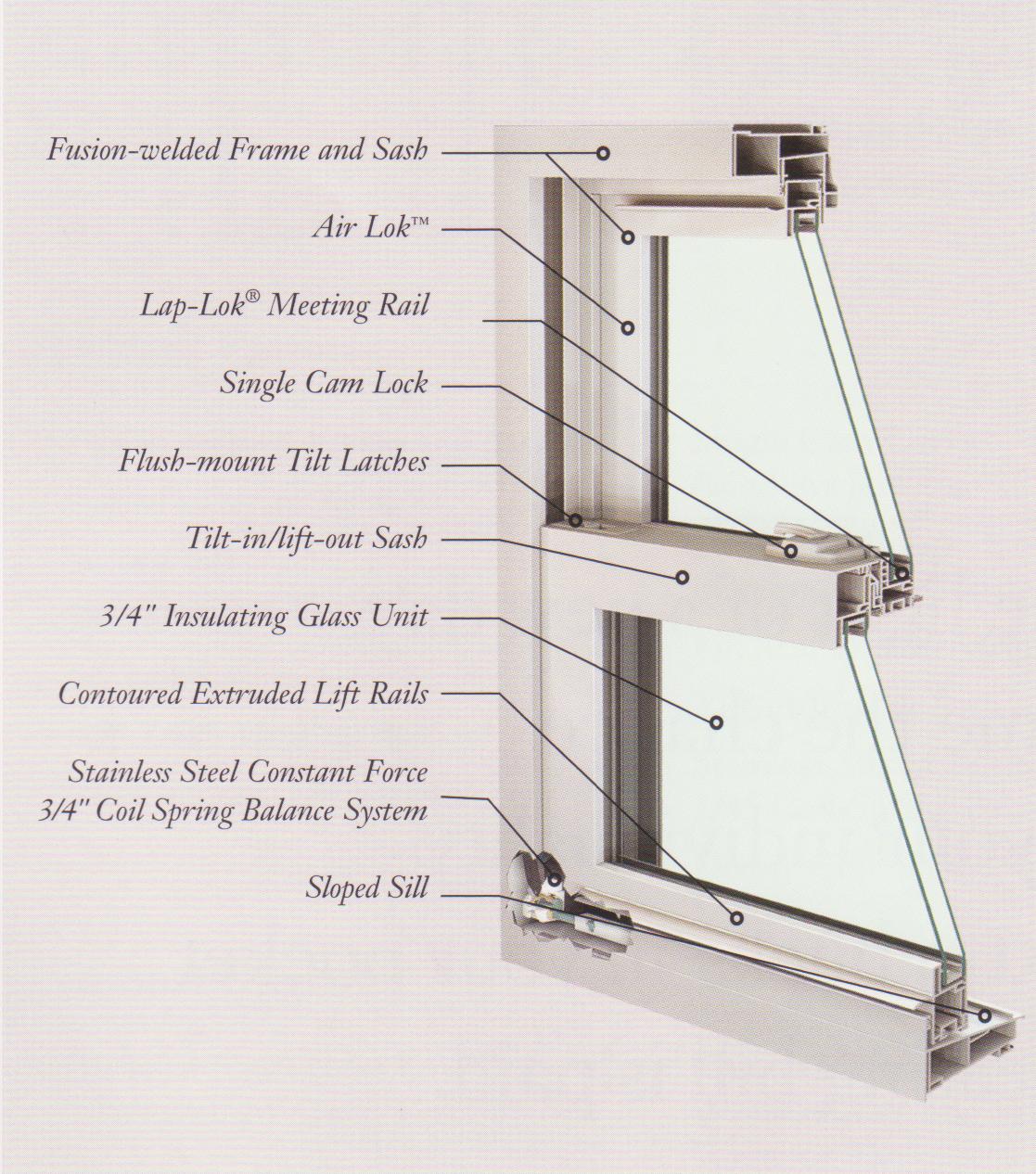
Unplasticised PVC is the most widely used frame material in Poland. Modern profiles come with five to seven internal chambers, each trapping still air to reduce conduction. A well-specified five-chamber PVC frame achieves Uf ≈ 1.2 W/m²K; seven-chamber profiles can reach Uf ≈ 0.9 W/m²K. Maintenance is minimal — the surface does not rot or require painting. The main limitations are lower rigidity compared to aluminium and some sensitivity to UV degradation in very exposed orientations, though modern stabiliser formulations significantly mitigate this.
Aluminium
Aluminium frames without a thermal break have Uf values of around 5–7 W/m²K — effectively useless for insulation. All aluminium systems used in residential construction must include a polyamide thermal break between the inner and outer shell. With a standard break, Uf falls to roughly 2.0–2.5 W/m²K; with enhanced breaks, 1.4–1.8 W/m²K is achievable. Aluminium is preferred where slim sightlines, large spans, or colour durability are priorities.
Timber and Timber-Aluminium Composites
Timber frames made from laminated pine or meranti can achieve Uf values similar to good PVC profiles. Composite systems — timber inside, aluminium cladding outside — combine the thermal performance of wood with the weather resistance of aluminium and eliminate the need for periodic painting. They are typically more expensive and heavier than uPVC alternatives.
Glazing: Low-E Coatings and Gas Fills
A Low-E (low-emissivity) coating is a microscopically thin metallic layer applied to one surface of the glass. It reflects long-wave infrared radiation — that is, the heat radiated by warm interior surfaces — back into the room, rather than allowing it to escape through the glass. Without a Low-E coating, double glazing with argon fill achieves roughly 1.5–1.7 W/m²K; with a good soft-coat Low-E, the same unit reaches 1.0–1.1 W/m²K.
Gas filling the cavity between panes with argon (instead of dry air) reduces thermal conductivity. Argon is used in the vast majority of modern double and triple glazing. Krypton has lower conductivity than argon but costs more; it is used in some premium triple-glazed units where space is limited, because it maintains performance in thinner cavities.
The Solar Heat Gain Coefficient (g-value)
The g-value (sometimes written as SHGC) measures what fraction of incident solar energy passes through the glass into the interior. A g-value of 0.62 means 62% of solar energy is admitted. For south-facing windows in Poland, a moderate-to-high g-value (0.50–0.65) is generally desirable in winter because solar gains reduce heating demand. For east- or west-facing windows — and especially for heavily glazed facades — a lower g-value may be needed to prevent overheating in summer.
Low-E coatings affect the g-value. There is a trade-off: coatings optimised for maximum solar gain (solar-control glass) reduce the g-value substantially and raise the U-value; coatings optimised for thermal insulation retain more solar energy. Check both figures when specifying glass for a specific orientation.
Airtightness Classes
EN 12207 classifies window airtightness from Class 1 (lowest) to Class 4 (highest). The classification reflects how much air leaks through the closed window under standardised pressure conditions. Class 4 products are typically used in passive house construction, where uncontrolled air infiltration undermines the performance of mechanical ventilation with heat recovery (MVHR). For standard new builds, Class 3 is common and generally sufficient when combined with competent installation.
Warm-Edge Spacer Bars
The spacer bar separates the two (or three) panes at the glass edge and is traditionally made from aluminium. Aluminium conducts heat well, creating a thermal bridge around the perimeter of the glazed unit. This not only raises the edge U-value but also causes the inner glass surface to be colder near the frame — leading to condensation. Warm-edge spacers made from stainless steel, foam, or plastic composites reduce edge heat loss. The improvement in whole-window U-value is typically 0.03–0.07 W/m²K — small in percentage terms, but meaningful in a high-performance window.
What to Ask Before Buying
- What is the certified Uw value for the window in the size I need? (Values vary with window size.)
- Does the product have an EN 14351-1 declaration of performance?
- What airtightness class does it achieve?
- What spacer bar system is used — aluminium or warm-edge?
- Is the installation covered by a separate warranty, distinct from the product warranty?
- Does the installer use the three-layer installation system (outer tape, foam, inner tape)?
Summary
For a typical detached house in Poland built since 2010 or undergoing renovation under the Czyste Powietrze programme, the practical target is a whole-window Uw of 0.90 W/m²K or lower, achieved with Low-E double or triple glazing in a five-chamber PVC or thermally broken aluminium frame, with warm-edge spacer bars and Class 3 or Class 4 airtightness. Installation quality is as important as product specification — budget for professional fitting, not just the frames.
Sources: Instytut Techniki Budowlanej (ITB) · EN ISO 10077 · WT 2021 (Rozporządzenie Ministra Infrastruktury)